Do You Need a Wrist Rest for a Mechanical Keyboard?
Short answer: it depends on your keyboard, your desk, and how you type, and a surprising number of people use one wrong, or buy one when they didn't need it at all.
If you've spent any time in the mechanical keyboard community, you already know this is one of those topics people argue about endlessly. Some swear a wrist rest saved their hands. Others insist they cause more harm than good. Both camps are partly right, and the confusion usually comes down to one thing most articles never explain clearly.
Let's fix that.
First: it's probably a palm rest, not a wrist rest

This is the single most important distinction, and it's the source of nearly every bad take on the subject.
A true wrist rest supports your wrist directly. That's the part you actually want to avoid. Resting the underside of your wrist on a hard surface while your fingers move puts pressure right where your tendons and nerves run, which is the opposite of what you're going for.
What you actually want is a palm rest: it supports the heel of your palm, the firm pad at the base of your hand, and lets your wrist hover in a neutral, straight line. Almost everything sold as a "wrist rest," including ours, is really doing the job of a palm rest. The name stuck; the function is what matters.
Once you understand that, the "wrist rests are bad for you" argument mostly dissolves. Pressing your wrist into something is bad. Supporting your palm so your wrist doesn't have to bend is good. This isn't just our opinion; OSHA's workstation ergonomics guidance makes the same point: when you rest, the pad should meet the heel or palm of your hand, not your wrist.
First: it's probably a palm rest, not a wrist rest

Here's how a rest is meant to be used, and it's not what most people do:
While you're actively typing, your hands should float. Fingers fly, wrists hover, palms hang just above the surface. The rest isn't bearing your weight in this moment.
When you pause, reading, thinking, scrolling, that's when your palms settle onto the rest.
So the rest isn't a place to mash your hands the entire session. It's there to keep your hands at the right height so that floating feels natural, and to give them a comfortable place to land between bursts. Get that rhythm down, and a good rest genuinely reduces strain. Treat it as a permanent hand-shelf, and you can create the exact problem you were trying to solve.
So do you need one? Check your keyboard height

Whether a rest helps you comes down mostly to how tall your board sits.
Tall, high-profile boards are standard on most mechanical keyboards, especially with a steeper typing angle, which puts your wrists in extension. That backward bend is the strain you feel after a long session. A palm rest lifts the base of your hands to meet the keyboard, keeping that line straight. If this is you, a rest is worth real consideration.
Low-profile boards and membrane keyboards sit closer to the desk, so your wrists stay closer to neutral on their own. You may not need a rest at all here, and forcing one in can actually raise your hands too high. Desk height plays a role, too, so it's worth a look either way.
Split and tented ergo boards are their own world. The raised center can push your wrists into extension, so a rest is often very welcome, though the right shape depends heavily on the board.
A quick gut check: sit at your desk and type a few sentences. If your wrists are visibly bending up to reach the keys, a palm rest will likely help. If they're already flat and relaxed, you may be fine without one.
Why material matters more than people expect

Once you've decided you want a rest, the material changes the whole experience.
Foam and gel are soft and cheap, and they feel nice for about a week. Then they compress, hold heat, and slowly flatten into a permanent dent. They also tend to be too squishy to keep your hands at a consistent height. Your palms sink, your wrists drift.
Acrylic and resin are firm and easy to clean, and the custom-pour resin pieces can look fantastic. Firmness is good; just make sure the edge where your palm meets it isn't a hard ninety-degree corner digging into you.
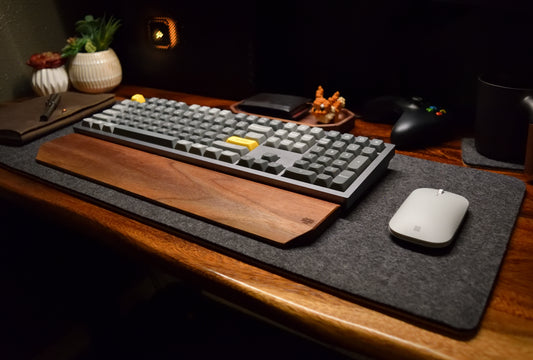
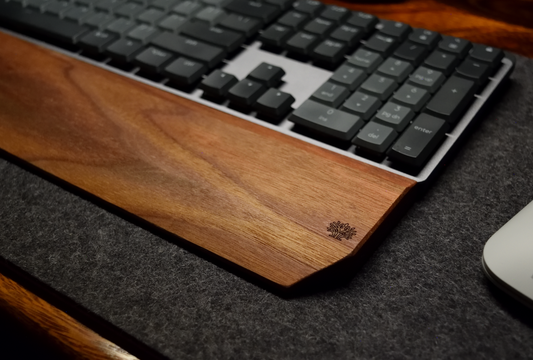
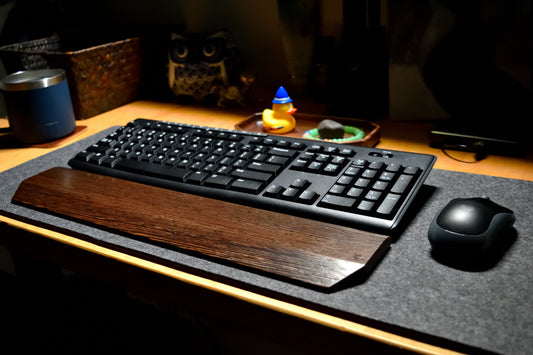
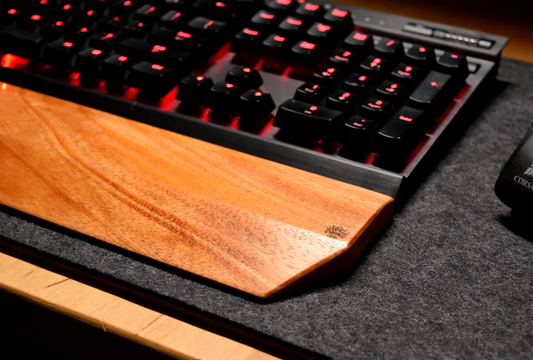
Hardwood is firm in a way that actually supports; it holds your palms at a steady height instead of letting them sink, it doesn't trap heat, and a properly finished one has a softly rounded front edge, so there's no pressure point. It also happens to age beautifully and outlast everything else on this list. (We're biased, obviously, it's what we make, but the ergonomic case for firm-but-smooth is the same one the broader community keeps landing on.)
What to look for when you buy

A few things worth checking, whatever you end up choosing:
- Height match. The top of the rest should sit roughly level with the front edge of your keyboard, so your hands stay in one flat line. A rest that's too tall is as bad as none at all.
- A rounded front edge. This is where your palm makes contact. A sharp edge creates a pressure line; a gentle radius doesn't.
- The right length for your layout. A 60% board, a TKL, and a full-size keyboard all want different widths. A rest that's too short leaves one hand hanging.
- A stable base. It shouldn't slide around mid-session. Either weight or a grippy underside works.
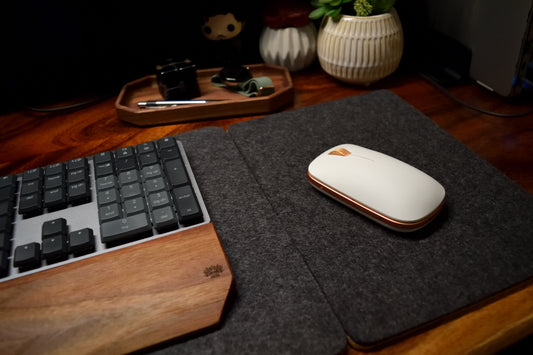
- Something you'll actually keep on your desk. Ergonomics only count if you use the thing. If it looks good, you'll leave it out, and that's half the battle.
Where ours fit in

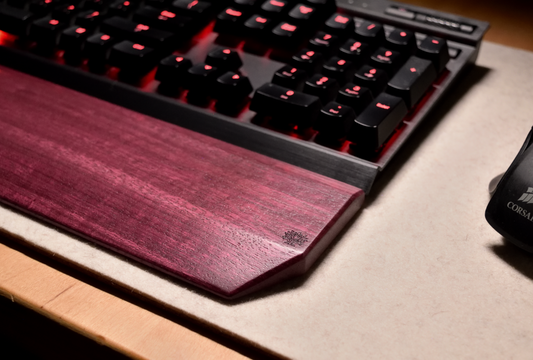
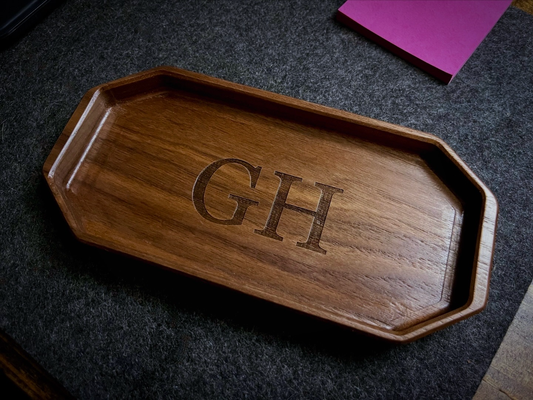
We make hardwood palm rests here in Texas, walnut, cherry, maple, and a few exotic woods, like Wenge and Purpleheart, each one cut and finished to order. Every rest gets a smooth, rounded front edge so there's no pressure point, a firm surface that holds your hands at a steady height, and a finish that's built to last years rather than flatten in a season. We also engrave them for free, so the thing supporting your hands every day can have your name, your handle, or whatever you like on it.
If you've worked out that a palm rest belongs in your setup, we'd love to be the one on your desk. And if you decide you don't need one, honestly, good. The right answer is whatever keeps your wrists straight and your hands happy.